The Fifth Wall: Why Designers Should Be Looking Up
In a beautifully designed room, nearly every surface is considered.
The floor establishes a foundation. Walls introduce color, texture, art, and materiality. Furniture creates form. Lighting shapes atmosphere.
And then, too often, we look up and find…white.
The ceiling has traditionally been treated as the quietest plane in the room—something to finish rather than something to design. But the fifth wall offers an entirely different opportunity.
Wallcovering makes that opportunity especially compelling. Pattern can move overhead. Color can change the perceived architecture of a space. An oversized graphic can become almost mural-like. And a surface that usually disappears can suddenly become one of the most memorable elements in the room.
As Audrey Lane's Holli Van Cleave puts it: “Don’t forget about the fifth wall.”

Runway Static Chestnut Cut
Make a Wild Moment
A feature wall creates a focal point. A covered ceiling can change the entire experience of a room.
In hospitality, an expressive ceiling can define a bar or lounge within a larger space. In a multifamily clubhouse, it can visually establish a seating area without adding walls. In a restaurant, it can draw the eye upward and make the dining experience feel more immersive.
And in high-end residential design, the fifth wall can transform dining rooms, bedrooms, entries, powder rooms, and other spaces that invite experimentation.
It doesn't necessarily mean covering everything in pattern.
“Sometimes you can run a lot of drama into a little bit of the space and just make a wild moment.” — Jennifer Horning
The ceiling may be one of the best places to do exactly that.
Imagine an otherwise restrained hotel lounge with an expressive botanical overhead. A dining room where quiet walls allow an abstract pattern to become the art. Or a powder room where wallcovering moves from wall to ceiling, eliminating the traditional boundary altogether.
Sometimes the most memorable element in the room can be the one guests don't expect.

Runway Plaid Undone Tuxedo
Scale Changes Everything
One of the most interesting things about taking pattern overhead is the amount of relatively uninterrupted visual space available.
Walls compete with doors, windows, furniture, artwork, and millwork. A ceiling can offer a much broader canvas.
That makes scale an important design tool.
Audrey Lane's Runway Wallcovering Collection offers two standard scales: Grande, with a 26-inch repeat, and Titan, with a 52-inch repeat spanning the full width of the roll. Scale can also be customized for the needs of a project.
The same artwork can feel completely different depending on that decision.
A smaller repeat may create rhythm and texture. Enlarging the artwork can make it feel less like traditional wallcovering and more like an installation—allowing individual brushstrokes, leaves, lines, or shapes to become part of the architecture.
Runway is particularly interesting here because the collection was curated around artwork rather than conventional wallcovering motifs. Hand-drawn lines, loose florals, botanicals, brushstrokes, and expressive abstractions can take on an entirely different personality overhead.
The question isn't simply, Do I like this pattern?
It's what do I want this pattern to do to the room?
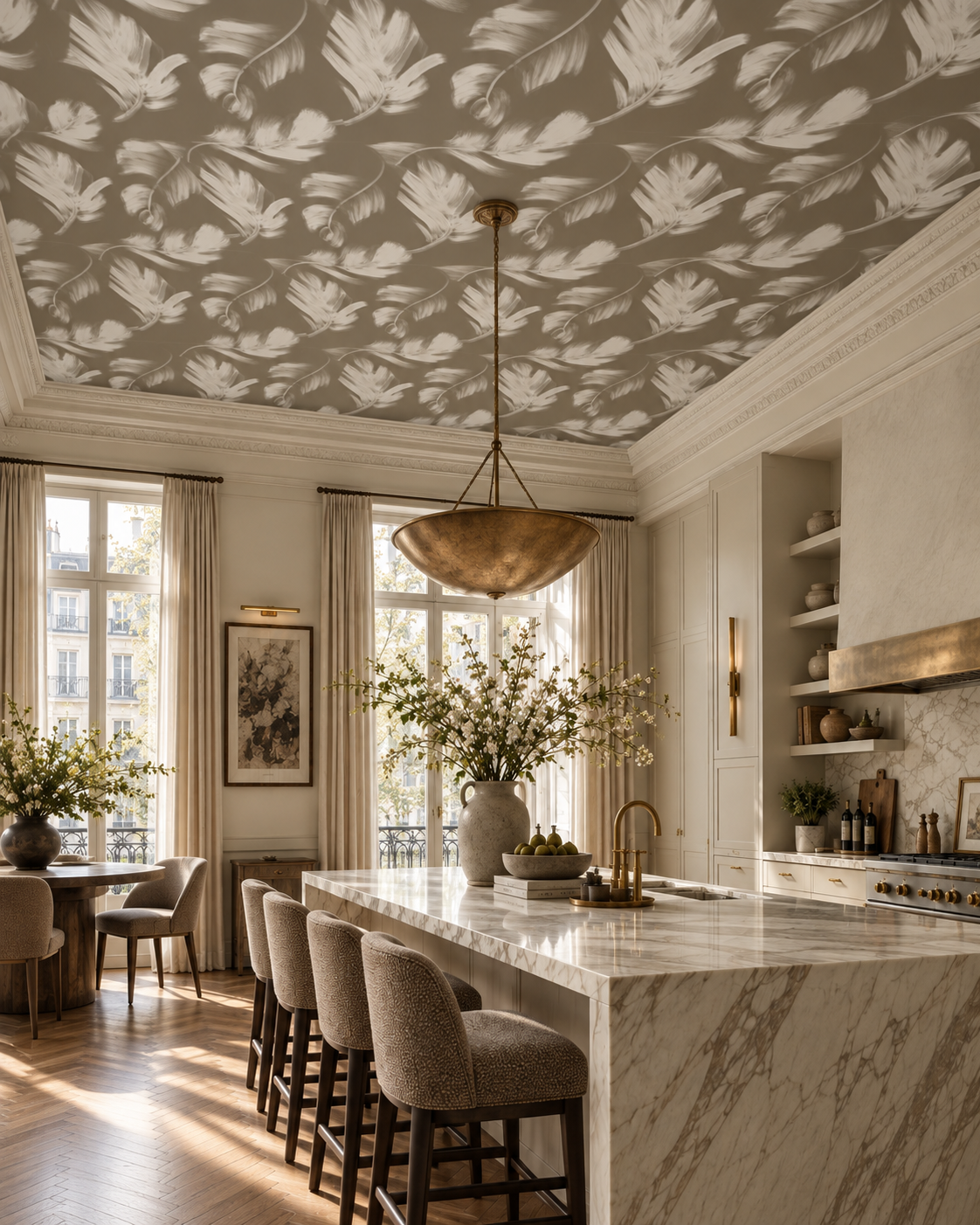
Runway Shadowleaf Cashmere
The Fifth Wall Doesn't Have to Shout
A wallcovered ceiling doesn't automatically mean maximalism.
Some of the most sophisticated applications may actually be the quietest.
A tonal graphic can introduce subtle movement. A botanical recolored in closely related shades can feel atmospheric rather than decorative. An abstract pattern can add depth overhead while allowing furnishings, lighting, and artwork to remain dominant.
This is also where customization becomes particularly powerful.
Runway patterns can be recolored to coordinate with a project palette, and scale can be adjusted beyond the collection's standard offerings.
“It’s really easy to customize. Give us the paint color you want to coordinate with and we can recolor the artwork, create a digital proof, produce a sample, make any changes you need, and we’re off to the races.”
— Jennifer Horning
So if you love the artwork but the existing color feels too bold for the ceiling, don't abandon the idea.
Keep the pattern. Shift the palette. Change the scale.
The collection is the starting point—not the limitation.
Blur the Boundaries
The fifth wall doesn't have to operate independently from the other four.
Take a pattern up a feature wall and continue it overhead. Wrap an intimate powder room completely. Connect a residential headboard wall to the ceiling above it. Or use wallcovering overhead to visually define a bar, reception area, conversation zone, or dining space without changing the architecture.
Lighting can become part of the composition too. Pendants, chandeliers, coves, and decorative fixtures interact with the pattern, adding another layer of light, shadow, and movement.
There is no design rule that says wallcovering needs to stop neatly at the corner.

Runway Custom Star
Creativity That Still Performs
For commercial designers, creative freedom still has to work in the real world.
Runway pairs its expressive, fashion-driven aesthetic with commercial performance. The standard wallcovering is a Type II vinyl with woven backing and a Class A fire rating, developed with hospitality, multifamily, and other demanding interiors in mind.
Ceiling applications should always be evaluated for project-specific substrate, adhesive, installation, fire and building-code requirements, and other conditions with the appropriate project team and wallcovering installer.
For a deeper dive into wallcovering construction, terminology, performance, and specification, explore Audrey Lane's Commercial Wallcovering 101: Everything Designers Need to Know.
Look Up
Runway was created around the freedom to experiment—with artwork, color, pattern, and scale.
“Runway is for the designer who wants to push boundaries, think outside the box, and make a wild space.”
— Jennifer Horning
That doesn't always mean designing the loudest room.
Sometimes it simply means noticing the surface everyone else forgot.
So on your next hospitality, multifamily, restaurant, or residential project, consider the walls. Consider the floor. Consider the furniture, lighting, artwork, and every carefully chosen detail.
Then look up.
The next statement wall might not be a wall at all.